Core Temperature Checks: Safe Cooking and Better Food Safety Records
Learn where to probe food, which cooking temperatures to use, how to avoid false readings and what to record in your kitchen’s food safety checks.
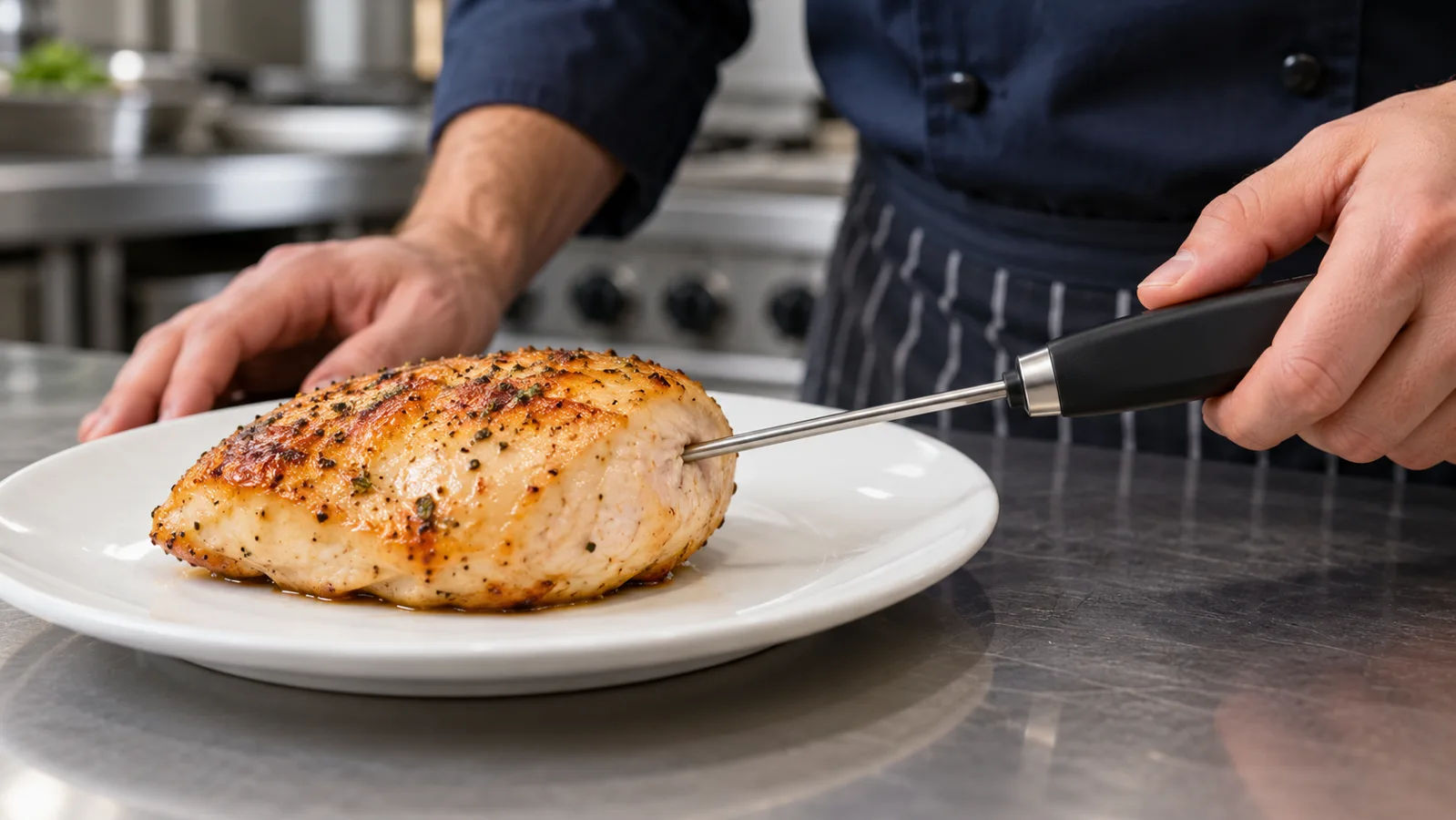
A browned surface doesn’t prove the centre is safe
Lunch orders are building up. The burgers look ready, the chicken is golden and the lasagne is bubbling around the edges.
But what’s happening in the middle?
Core temperature checks help catering teams confirm that food has reached their safe cooking target. They also give cooking records a clear basis: an actual measurement taken before the food leaves the kitchen.
What does core temperature mean?
- Core temperature
The temperature inside the food. For a cooking check, the aim is to measure the part that heats most slowly, usually the centre of the thickest section.
An oven display tells you the oven’s temperature. An infrared thermometer measures a surface. Neither tells you the temperature at the centre of a chicken breast or burger.
Visual checks can support an established cooking method, but browning alone can mislead. A probe gives a direct measurement at the point being tested.
It still needs to be used properly. A hot reading from the wrong place can give false confidence.
Which core temperature should food reach?
The Food Standards Agency’s cooking guidance gives a standard target of 70°C for two minutes, with equivalent combinations including:
| Core temperature | Minimum time at that temperature |
|---|---|
| 70°C | 2 minutes |
| 75°C | 30 seconds |
| 80°C | 6 seconds |
Choose the appropriate combination for your documented safe method. Make sure staff understand the holding time as well as the temperature.
These are recognised cooking combinations, not a claim that every food must legally reach one identical temperature. Specialist processes need their own properly validated controls.
Common catering items that need attention
Poultry, burgers, sausages and other minced meat products need thorough cooking throughout. Whole cuts of beef or lamb can be treated differently from minced, rolled or stuffed products, so don’t apply steak-cooking assumptions to a burger.
| Food or dish | Where the check needs attention |
|---|---|
| Chicken portions | Thickest section, away from bone |
| Burgers | Centre of the patty, inserting from the side where practical |
| Sausages | Centre of the thickest section |
| Minced meat dishes | Centre and other potentially cooler locations in a large dish |
| Stuffed items | Centre of the filling as well as the surrounding food |
| Reheated meals | Coldest locations, especially in deep or uneven portions |
Follow the product instructions and your established safe method. For large or uneven dishes, one convenient reading may miss a cooler area.
How to take a reliable core temperature reading
The FSA’s probe guidance explains checking the centre or thickest part with a clean, disinfected probe.
Prepare the thermometer
Check that it’s suitable for the food and that its accuracy checks are up to date. Clean and disinfect the probe using your approved method.
Find the right location
Position the sensing section in the centre of the thickest part. Follow the thermometer’s instructions for insertion depth. Avoid touching bone, the tray or the cooking surface.
Let the reading settle
Wait for the display to stabilise. Don’t record a number while it’s still changing. Then confirm the required time at the target temperature.
Check additional locations when needed
Large dishes, uneven portions and mixed loads may need more than one check. Follow the sampling approach in your safe method.
Record the result and act
Enter the actual result. If the target hasn’t been achieved, continue cooking where appropriate and check again before release.
Clean and disinfect the probe between uses. Include the handle in your hygiene routine where it could become contaminated.
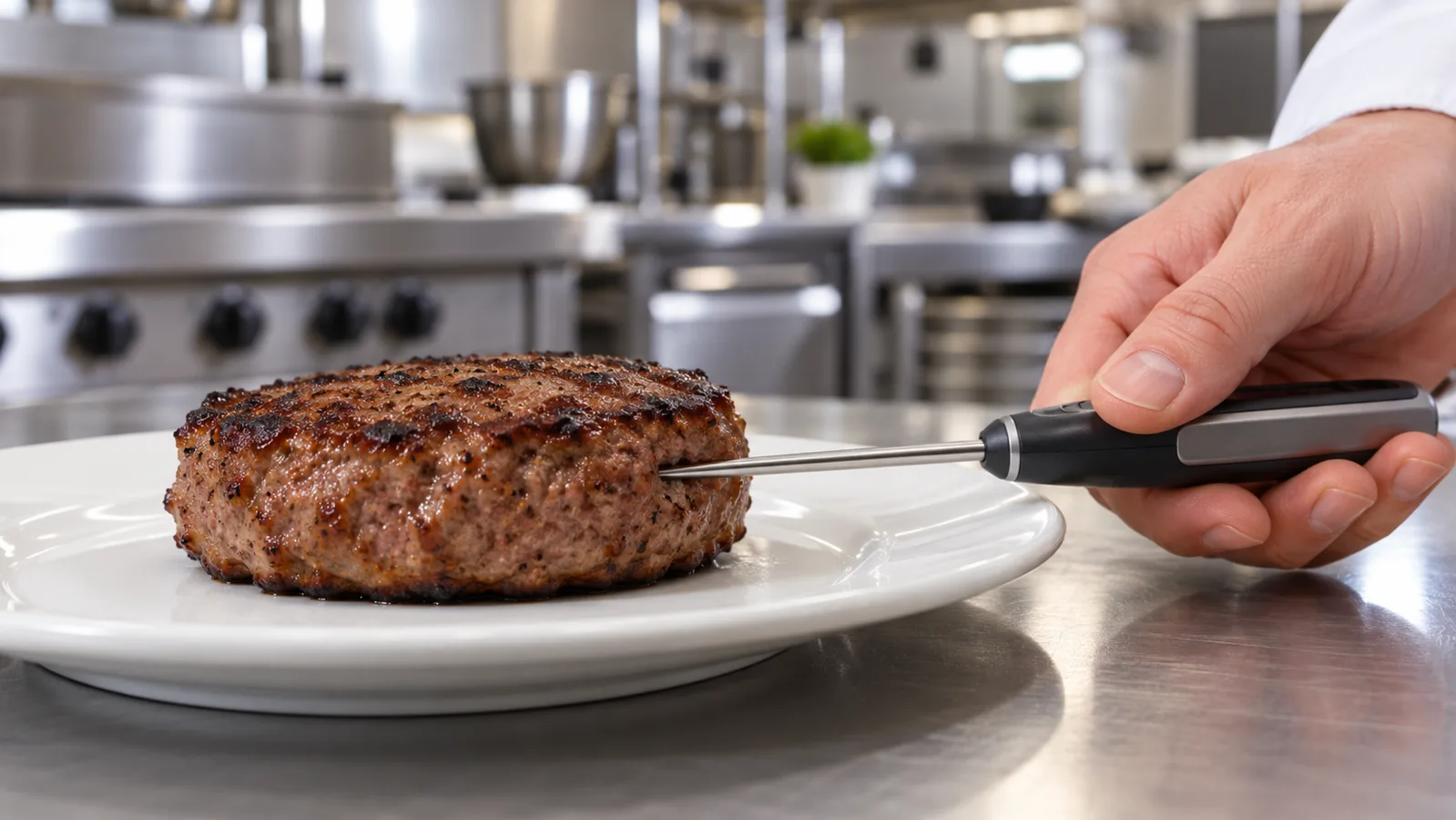
Mistakes that turn a check into guesswork
| Mistake | Better working practice |
|---|---|
| Checking only the browned surface | Measure the centre of the thickest section |
| Removing the probe immediately | Wait for the reading to stabilise |
| Recording the target instead of the result | Enter what the thermometer actually shows |
| Checking the smallest piece in a mixed batch | Follow a sampling method that considers larger pieces and cooler positions |
| Treating one successful batch as proof for every batch | Repeat checks at the frequency set in your food safety system |
| Filling in records after service from memory | Record the check when it happens |
| Ignoring a low reading | Record corrective action and the repeat check |
Busy lunch service: burgers before dispatch
Build the check into the route from grill to service.
The cook checks the burger using the agreed method before it goes into the bun. If it misses the target, it stays out of service while cooking continues.
For mixed thicknesses or different grill loads, review whether the normal sampling approach still gives a reliable picture.
Batch cooking chicken for later service
Check the thickest section of the selected pieces, following the batch-checking method. Record which batch the result belongs to.
Cooking is only one stage. If the chicken won’t be served immediately, it also needs an appropriate hot-holding or cooling process. A successful cooking reading doesn’t prove those later stages were controlled.
Reheating and hot holding are separate checks
Reheating needs to make the food safely hot throughout. Hot holding then maintains it at the required temperature.
Don’t use a hot-holding reading as evidence that the reheating stage was completed properly.
For example, a prepared dish should complete its reheating check before transfer into suitable, preheated holding equipment.
Government guidance states that hot food should normally be held at 63°C or above and that food should only be reheated once.
See Food Standards Scotland’s CookSafe guidance and the Scottish reheating provisions.
What should a cooking temperature record include?
A useful record should let someone understand what was checked and what happened next.
The following is an example record structure, not a universal legal form.
| Field | What to enter |
|---|---|
| Date and time | When the food was checked |
| Food item | Clear dish or product name |
| Batch or location | Enough detail to identify the food |
| Target | Required temperature and holding time |
| Actual result | Measured temperature and confirmation of the required time |
| Staff identification | Initials or an identifiable staff entry |
| Corrective action | What happened when the target wasn’t met |
| Repeat check | Result before the food was released |
Avoid recording only “passed”. A reviewer needs enough information to understand the basis for that decision.
What automatic timestamps can help with
Where a recording system automatically timestamps entries, it can reduce repeated typing and make the sequence of checks easier to review.
The timestamp still needs context. An entry saved at 12:45 doesn’t prove that the food was measured at 12:45 if someone entered it later.
Keep the device clock correct, record checks promptly and identify delayed entries honestly. Automatic timestamps support traceability; they don’t verify the temperature measurement.
Keep the probe accurate
A thermometer can look fine and still give an unreliable reading.
Follow the manufacturer’s instructions for accuracy checks, frequency and calibration. Keep a record of the check result and any action taken.
An accuracy check tests performance. Calibration or adjustment may need a different process, depending on the instrument.
If a probe fails its check, take it out of use and arrange a suitable replacement or calibration. Consider whether earlier food checks need review.
Before relying on a probe
- It’s suitable for the food and measurement range.
- The sensing section and insertion requirements are understood.
- The probe is clean and disinfected.
- Accuracy checks are current and acceptable.
- Staff know what to do if a result is doubtful.
Review records after the rush
A head chef’s review should look beyond completed boxes.
Useful questions include:
- Are checks recorded before food is released?
- Do results identify the food or batch clearly?
- Are required holding times addressed?
- Do missed targets have corrective actions and repeat checks?
- Are there gaps during the busiest period?
A later spot-check can assess food still under control, but it can’t recreate a missing cooking check for food already served.
Use repeated problems to improve the process. That might mean changing portion size, reducing oven loading or moving the recording device closer to the cooking station.
Connect cooking checks with wider food safety records
HACCP Records.app includes cooking, reheating, hot-holding, probe calibration and corrective action records. Its configurable temperature settings should reflect the safe methods used in your business.
Keep those stages distinct so a reviewer can follow the food through the process. Structured digital food safety records and PDF exports can support internal reviews, audits and inspections.
A food safety app helps organise the evidence. Staff still need to take reliable measurements, follow safe methods and respond when targets are missed.
For related hygiene guidance, read how to prevent cross-contamination between raw meat and ready-to-eat food.
Download HACCP Records.appCommon questions about core temperature checks
Is reaching 75°C enough on its own?
The FSA combination shown here is 75°C for at least 30 seconds. Confirm both parts of your chosen target using a reliable measurement.
Can I use an infrared thermometer for the core check?
An infrared thermometer measures the surface. Use a suitable penetration probe when you need to measure inside the food.
Must every individual item be probed?
Checking frequency and sampling should follow your documented food safety system and validated cooking method. Don’t assume one reading represents every item in an uneven load.
What if the food doesn’t reach the target?
Keep it out of service. Continue cooking where appropriate, recheck and document the action and final result. If safety is uncertain, don’t serve it.
Do digital records guarantee a successful inspection?
No. Records help explain your controls, but inspectors also consider how the kitchen operates and whether those controls are effective.
Sources and further reading
Guidance checked on 30 October 2026.
- GOV.UK: cooking food safely
- FSA: proving cooking, reheating and hot-holding methods, including probe checks
- Food Standards Scotland: CookSafe guidance
- The Food Hygiene (Scotland) Regulations 2006
Images are AI-generated illustrations of cooking checks.